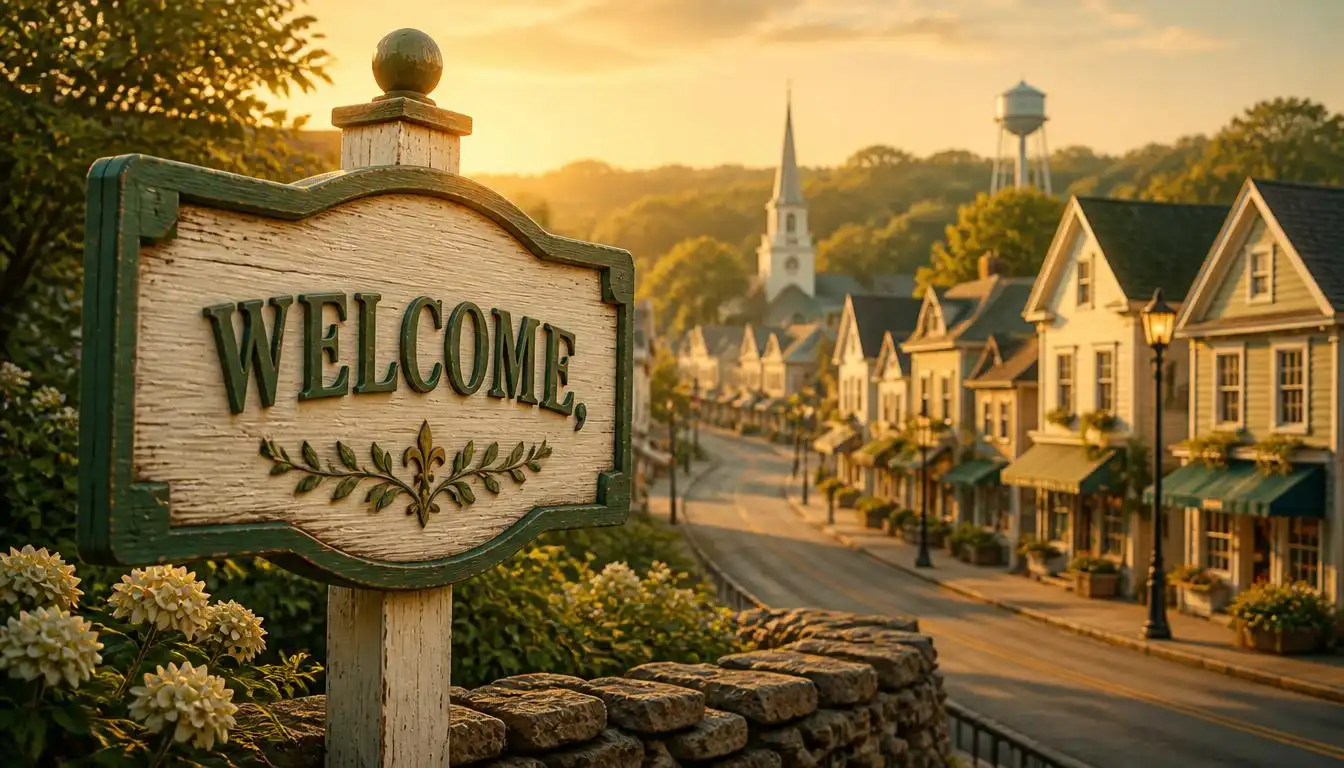

The best way to find names for fictional towns is to match the name to its job in your story. Cozy settings want soft, warm sounds (Honeybrook, snugbury) horror wants blunt, heavy ones (Gallows Ridge, grimshaw) satire wants deliberate absurdity (Much muddling, boring).
This guide combines and refines three separate name libraries into one single deduplicated master list of 185+ unique town names categorized by genre with a description of the story type it is best suited for.
Every invented name here sounds like it grew from real history rather than a generator due to the naming patterns behind the list are drawn from documented English place-name etymology the same suffix system recorded in the domesday book of 1086.
Best Names for Fictional Towns at a Glance
| Name | Meaning | Best For |
| Thistlewick | Thistle + -wick, an old suffix for a dwelling or trading place | Cozy mysteries and village novels |
| Marrow Creek | “Marrow” suggests something deep-rooted; creek anchors it in rural America | Slow-burn small-town drama |
| Larkspur Landing | A flowering plant + “landing,” a riverside settlement | Romance and cottagecore stories |
| Hollowpine | Hollow + pine | An isolated forest town with secrets |
| Saltreach | Salt + reach (a stretch of water) | Coastal or fishing towns |
| Ashfall | Ash + falling | Post-disaster or volcanic settings |
| Pennywhistle | A small, cheap tin flute | Whimsical children’s books |
| Gallows Creek | Gallows + creek | Horror, western, or grim mystery |
| Brambleford | Bramble (thorny bush) + ford (river crossing) | Rustic fantasy villages |
| Dunemarch | Dune + march (borderland) | Desert-edge or frontier settlements |
| Willowholt | Willow + holt (a wood) | Gentle fantasy and pastoral fiction |
| Brightwater | Bright + water | An optimistic, prosperous small city |
How Real Town Names Are Built
Convincing fictional towns copy the way real ones formed. English place names usually combine a landscape element (river, hill, tree) with a settlement suffix, and many of these patterns were already standard by the time of the Domesday Book in 1086.
Treat the table below as a hand-built town names generator: pair a suffix with a tree, a terrain feature, a surname, or a trade, and the result almost always sounds authentic.
The same logic explains why fictional towns like Castle Rock (Stephen King) and Stars Hollow (Gilmore Girls) feel real they follow the same grammar as actual place names.
| Suffix / Element | What It Means | Best For |
| -ton | Old English tūn: enclosure, farmstead | Classic, everyday English-style towns |
| -wick | Old English wīc: dwelling or trading place | Cozy villages and market settlements |
| -ham | Homestead or village | Traditional, established towns |
| -by / -thorpe | Old Norse: farm, outlying settlement | Northern, Viking-flavored settings |
| -ford | River crossing | Towns beside rivers |
| -mere | Lake or pool | Misty lakeside settings |
| -combe | Short valley | Hidden, sheltered villages |
| -holt | Wood or thicket | Forest-edge settlements |
| Hollow, Gulch, Junction, Landing | American landscape and transport terms | US-set stories |
Classic & Cozy Small-Town Names
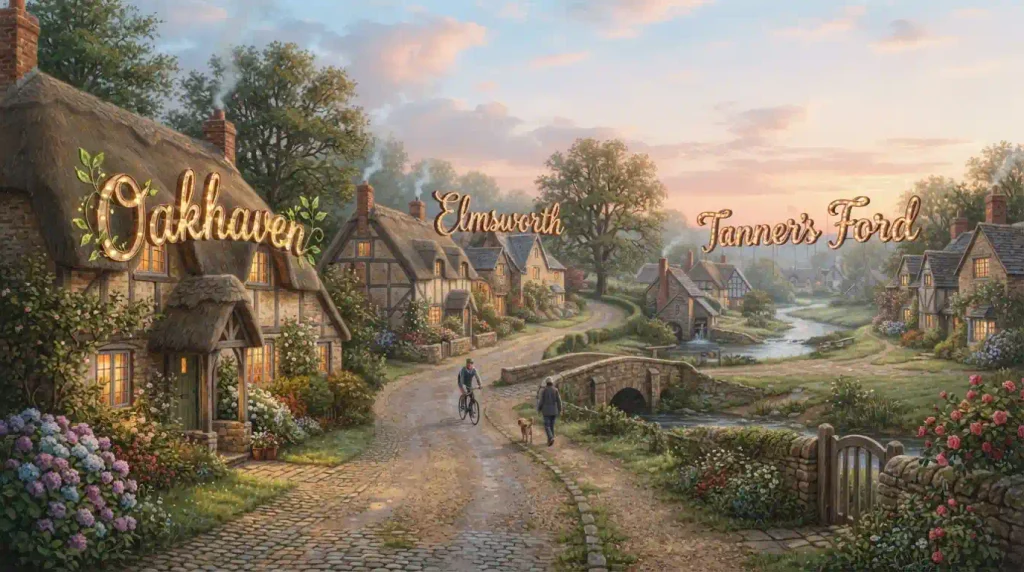
Maplewood
Meaning: Literally a wood of maple trees; also a common real surname-style name.
Best For: Classic Americana where everyone knows everyone.
Cedar Hollow
Meaning: Cedar trees in a sheltered valley.
Best For: Forest towns that feel safe — useful contrast if danger arrives later.
Oakhaven
Meaning: Oak trees + haven, a safe harbor.
Best For: Wholesome community stories with a long local history.
Elmsworth
Meaning: Elm trees + -worth, an old term for an enclosure.
Best For: A tidy, slightly formal market town.
Brackenridge
Meaning: Bracken (a large fern) growing on a ridge.
Best For: Hillside settings with a rugged edge.
Alderbrook
Meaning: Alder trees beside a small stream.
Best For: Quiet, damp-woodland towns.
Harrowfield
Meaning: A harrow is a farm tool for breaking up soil; the field is where it works.
Best For: Farming communities and agricultural mysteries.
Fairhollow
Meaning: Fair, as in pleasant, plus a sheltered hollow.
Best For: Feel-good ensemble fiction.
Linden Grove
Meaning: A stand of linden trees.
Best For: Leafy college towns and affluent suburbs.
Greywater
Meaning: Grey + water, suggesting overcast skies over a river or lake.
Best For: Sober, atmospheric dramas.
Ryecroft
Meaning: Rye grain + croft, a small enclosed field.
Best For: English-style farming villages.
Honeycrest
Meaning: Sweetness on a hilltop.
Best For: Bakery-centered cozy fiction.
Brookfield
Meaning: A field beside a brook.
Best For: Traditional family sagas.
Birchmont
Meaning: Birch trees on a hill.
Best For: New England-style settings.
Juniper Bend
Meaning: A curve in the road lined with juniper.
Best For: Road-trip novels and journeys through open country.
Windmere
Meaning: Wind moving over a lake.
Best For: Lakeside dramas.
Pondhollow
Meaning: A quiet hollow holding a still pond.
Best For: Summer-camp settings and childhood nostalgia.
Honeybrook
Meaning: Honey + brook.
Best For: Idyllic countryside towns in romance and middle-grade fiction.
Cute & Whimsical Town Names
Buttercup Bend
Meaning: The yellow wildflower plus a curve in a road or river.
Best For: Sunny picture books and feel-good romances.
Marmalade Green
Meaning: Marmalade suggests preserves and breakfast; a green is a village common.
Best For: Bakery, tea-shop, and cozy-café stories.
Dumpling Hill
Meaning: Comfort food paired with a rounded hill.
Best For: Children’s animation and food-centered fiction.
Thimblewick
Meaning: A sewing thimble + -wick, a small settlement.
Best For: A town of tailors, quilters, and craftspeople.
Cricketwell
Meaning: Crickets + a water well.
Best For: Summer-evening nostalgia.
Toffee Creek
Meaning: A sweet treat beside a small stream.
Best For: Candy-shop themes and light comedy.
Puddlecombe
Meaning: Puddle + -combe, a short valley.
Best For: Rainy, storybook English villages.
Nutmeg Hollow
Meaning: The warm autumn spice in a sheltered dip in the land.
Best For: Fall-season cozy fiction.
Snugbury
Meaning: “Snug” + -bury, an old ending for a fortified place.
Best For: A village that feels like a warm blanket.
Cobbleby
Meaning: Cobblestones + the Norse -by for a village.
Best For: Narrow, old-world lanes.
Tuppenny Green
Meaning: “Tuppence” is old British slang for two pence, suggesting humble prices.
Best For: Period settings with market-village warmth.
Biscuit Bridge
Meaning: A homely food word paired with a river crossing.
Best For: Southern-flavored rural comedy.
Cuddlecombe
Meaning: Cuddle + -combe, a short valley.
Best For: Deliberately adorable settings in picture books and cozy games.
Gigglewick
Meaning: A coined blend of “giggle” and the settlement suffix -wick.
Best For: Playful children’s fiction.
Bumblebrook
Meaning: Evokes bumbling bees drifting over a lazy stream.
Best For: Cozy comedies with pastoral charm.
Pebblebrook
Meaning: Pebble + brook.
Best For: Gentle small-town settings and early-reader fiction.
Funny Names for Fictional Towns
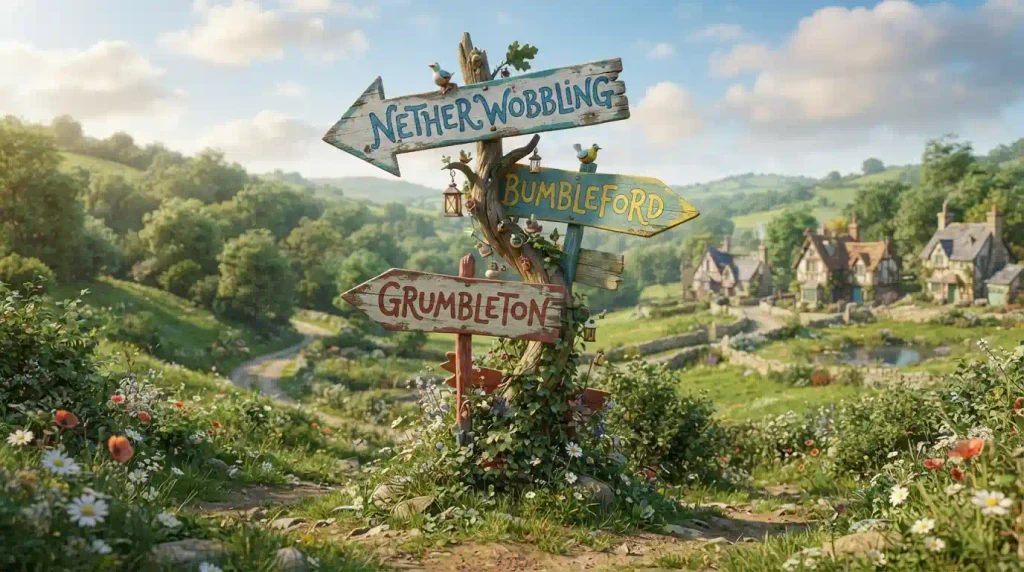
English village comedy leans on prefixes like Upper, Lower, Nether, and Much (an old intensifier meaning “great,” as in the real town of Much Wenlock in Shropshire). These names work best when the story is in on the joke.
Nether Wobbling
Meaning: “Nether” means lower; the joke is the wobble.
Best For: Parody of English village dramas.
Much Muddling
Meaning: Follows the authentic “Much” prefix, with the pun on confusion.
Best For: Farces where nobody understands what’s happening.
Lower Dithering
Meaning: A place defined by indecision.
Best For: Satirical council-meeting plots.
Snoreham
Meaning: Snore + -ham, an old ending for a homestead.
Best For: A sleepy town where nothing happens — on purpose.
Gouda Gulch
Meaning: A Dutch cheese dropped into a western ravine.
Pronunciation: GOW-da in the US; KHOW-da for the Dutch original.
Best For: Comic westerns.
Bumbleford
Meaning: Bumble (to stumble along) + a river crossing.
Best For: Clumsy-hero comedies.
Boggle Bottom
Meaning: “Bottom” is a low-lying valley; boggle means to be baffled.
Best For: Absurdist adventure in a swampy setting.
Fumblesham
Meaning: Fumble + -ham (homestead).
Best For: Bumbling-detective spoofs.
Grumbleton
Meaning: Complaint + -ton.
Best For: A town full of lovably grumpy neighbors.
Yawnington
Meaning: Yawn + -ington, a common English ending.
Best For: Deadpan mock-boring settings.
Boring
Meaning: Literally dull — and a real town name in Oregon.
Best For: Deadpan comedy where the joke is the name itself.
Dullsville
Meaning: Slang for an uneventful place.
Best For: Teen protagonists who can’t wait to leave.
Lost Springs
Meaning: Lost + springs; also a real Wyoming town famous for its tiny population.
Best For: Jokes about obscurity and remoteness.
Accident
Meaning: Literally an unintended event — a real town in Maryland, reportedly named after a land-survey mishap.
Best For: Comic founding stories.
Why
Meaning: The question word — a real place in Arizona, named for the shape of two roads forming a Y.
Best For: Absurdist humor and meta-jokes about naming.
Puddleby
Meaning: Puddle + -by (settlement).
Best For: Comic fantasy and children’s humor.
Spooky, Gothic & Mysterious Town Names
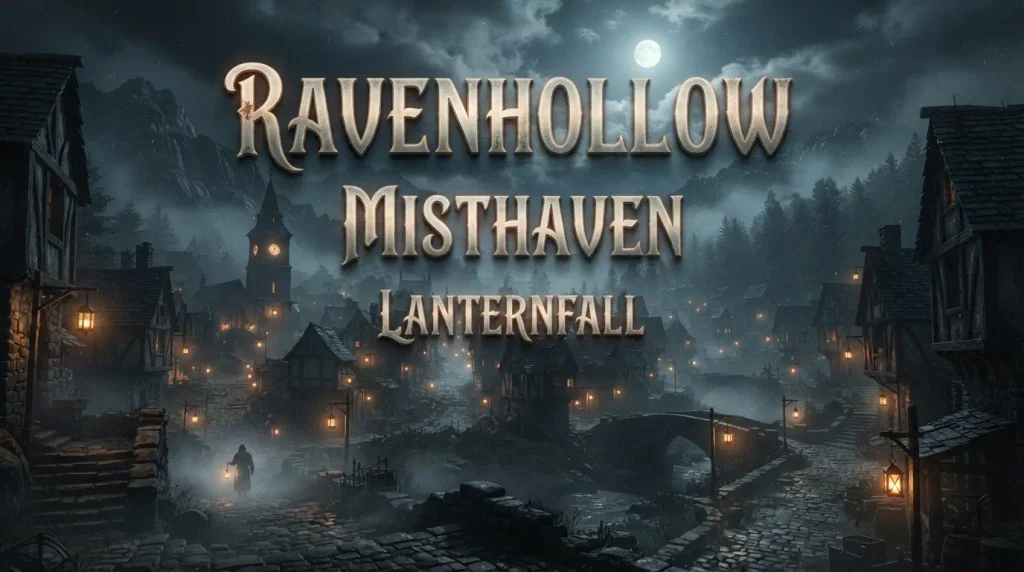
The strongest horror names pair something beautiful with something threatening. If your town needs dread before anything happens, start here.
Gallows Ridge
Meaning: A place of executions, on high ground.
Best For: Folk horror and dark historical thrillers.
Fenmoor
Meaning: Fen (wetland) + moor (open upland) — a bleak pairing of terrains.
Best For: Gothic novels and slow-building dread.
Ravenhollow
Meaning: Ravens plus a sunken hollow.
Best For: Classic supernatural mysteries.
Blackthorn Reach
Meaning: A spiny shrub plus “reach,” a stretch of land or water.
Best For: Dark fairy-tale fantasy.
Misthaven
Meaning: Fog + haven — a refuge that hides more than it protects.
Best For: Ghost stories.
Mourning Creek
Meaning: Grief attached to a stream.
Best For: Tragedies and Southern gothic.
Lanternfall
Meaning: Lights descending — an eerie image rather than a literal meaning.
Best For: Atmospheric supernatural fiction.
Coldharrow
Meaning: Cold + a harrow, a farm tool.
Best For: Bleak rural horror.
Witchbell
Meaning: Invented; combines witchcraft imagery with a bell.
Best For: Small towns with folk-magic secrets.
Grimshaw
Meaning: Grim + shaw, an old word for a small wood or thicket.
Best For: Bleak northern towns.
Crowmere
Meaning: A crow-haunted lake.
Best For: Ominous villages and cursed waters.
Gloomhollow
Meaning: A valley of gloom.
Best For: Gothic romance.
Wraithwick
Meaning: A settlement frequented by wraiths.
Best For: Ghost stories and haunted histories.
Nightshade
Meaning: A beautiful, poisonous plant.
Best For: Witchy towns with a charming surface.
Cryptwell
Meaning: A well of buried secrets.
Best For: Underground mysteries.
Mourningvale
Meaning: A valley steeped in grief.
Best For: Tragic histories and dark family sagas.
Fantasy Village & Kingdom Town Names
These follow real place-name grammar, so a whole region of them reads as though it came from one language — even without a full conlang.
Dawnspire
Meaning: Invented; dawn plus a tall pointed tower.
Best For: Elven or holy-order settlements.
Faerwick
Meaning: Invented; a fairy-tale spelling of “fair” + -wick.
Pronunciation: FAIR-wik
Best For: Gentle, storybook magic.
Runeford
Meaning: Runes (ancient script) + a river crossing.
Pronunciation: ROON-ford
Best For: Norse-inspired fantasy.
Highmoot
Meaning: “Moot” derives from an old English word for a meeting or assembly.
Pronunciation: HY-moot
Best For: Council-governed settlements.
Dragonsbarrow
Meaning: A burial mound linked with dragons.
Best For: Adventuring-party quest hubs.
Moonshade
Meaning: Shadow cast by moonlight.
Best For: Twilight-realm towns.
Ironvein
Meaning: A seam of iron ore.
Best For: Dwarven or mining strongholds.
Wyverndale
Meaning: A two-legged dragon relative + a valley.
Best For: Highland fantasy.
Glimmerfen
Meaning: A glowing wetland.
Best For: Swamp-magic locales.
Emberhold
Meaning: A fortress kept warm by inner fire.
Best For: Resilient, war-tested cities.
Stormgard
Meaning: A place guarded against the storm.
Best For: Storm-lashed coastal realms.
Nightspire
Meaning: A tower piercing the darkness.
Best For: Magical capital cities.
Aurelian
Meaning: Evokes the Latin aureus, meaning golden.
Pronunciation: aw-REE-lee-an
Best For: Sun-blessed empires.
Starhaven
Meaning: A refuge beneath the stars.
Best For: Celestial-themed fantasy.
Elderfen
Meaning: Elder tree + fen.
Best For: Villages in a marshy, ancient landscape.
Oakenshield
Meaning: Oaken + shield.
Best For: Defensive villages with a martial history.
Nature & Wilderness Town Names
Mosshollow
Meaning: A damp, green, forgotten hollow.
Best For: Forest-dwelling communities.
Riverbend
Meaning: A town at the river’s curve.
Best For: Trading and fishing settlements.
Frostpine
Meaning: Snow-dusted pines.
Best For: Northern adventures.
Sunfall
Meaning: The place where the sun goes down.
Best For: Western frontiers and liminal settings.
Rainmere
Meaning: A lake fed by constant rain.
Best For: Misty, moody settings.
Wilderglen
Meaning: An untamed valley.
Best For: Frontier fantasy.
Heatherdown
Meaning: Hills covered in heather.
Best For: Moorland fiction.
Cloudrest
Meaning: A place above the clouds.
Best For: Mountain-top settings.
Timberfall
Meaning: Felled timber, or a waterfall in a forest.
Best For: Logging-town settings.
Bearpaw Gap
Meaning: A bear track marking a narrow mountain pass.
Best For: Rugged outdoor adventure.
Aspenrise
Meaning: Aspen trees on a slope.
Best For: Ski towns and mountain retreats.
Wolfmeadow
Meaning: Wolves in open grassland.
Best For: Wildlife-focused or werewolf tales.
Coastal & Harbor Town Names
Gullhaven
Meaning: Gulls + haven.
Best For: Working fishing ports.
Driftwood Cove
Meaning: Sea-worn timber in a sheltered bay.
Best For: Beachside mysteries.
Tidewell
Meaning: Tide + a well or spring.
Best For: Villages where the sea shapes daily life.
Brinehaven
Meaning: Salt water + haven.
Best For: Smuggler-era fiction.
Pearlmouth
Meaning: Pearl + “mouth,” a river’s outlet.
Pronunciation: PURL-muth, following the English habit of shortening “-mouth.”
Best For: Old shipping towns with a touch of luxury.
Stillwater Quay
Meaning: Calm water beside a stone landing place.
Best For: Peaceful harbor towns with something hidden beneath.
Beacon Bluff
Meaning: A signal fire or lighthouse on a cliff.
Best For: Lighthouse-keeper stories.
Whalebone Bay
Meaning: Evokes the whaling era.
Best For: Historical maritime fiction.
Tidesend
Meaning: Tide + end — the furthest the water reaches.
Best For: Towns at the edge of the map.
Seafoam Landing
Meaning: Seafoam + landing.
Best For: Tourist towns with a nautical theme.
Gullwing
Meaning: Gull + wing.
Best For: Towns defined by seabirds and wind.
Breakwater
Meaning: A structure that protects a harbor.
Best For: Towns that exist to hold something back.
Western & Frontier Town Names
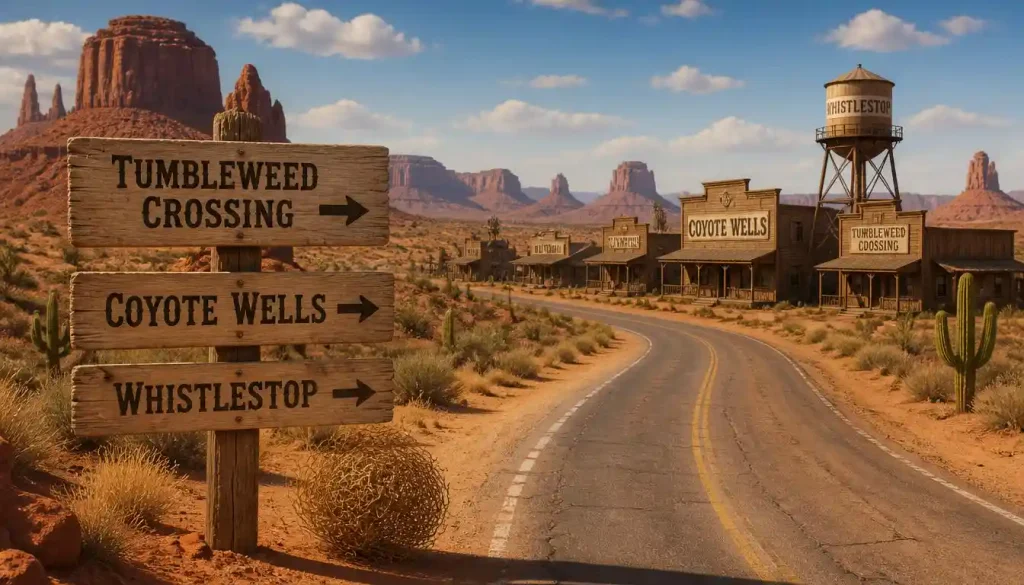
Frontier names are blunt and functional — they sound like they were chosen by people with no time for poetry.
Tumbleweed Crossing
Meaning: Wind-blown desert plants where a trail meets a road.
Best For: Classic westerns.
Prospect Flats
Meaning: Prospectors searching for minerals on level ground.
Best For: Gold-rush tales.
Copper Gulch
Meaning: Copper mining in a narrow ravine.
Best For: Mining-camp drama.
Dry Fork
Meaning: A river branch with little or no water.
Best For: Drought-stricken towns.
Bonanza Flats
Meaning: “Bonanza” is a rich mineral strike.
Best For: Boomtown stories.
Lonesome Butte
Meaning: An isolated flat-topped hill.
Best For: Remote outpost fiction.
Vermilion Wash
Meaning: Red-orange rock and a dry riverbed.
Pronunciation: ver-MIL-yun
Best For: Colorful red-rock desert landscapes.
Mesquite Bend
Meaning: A thorny desert tree beside a curve in the trail.
Pronunciation: meh-SKEET
Best For: Texan and Southwestern locales.
Nugget Ridge
Meaning: Gold pieces on high ground.
Best For: Gold-fever fiction.
Whistlestop
Meaning: A small railway station where trains stop only on request.
Best For: Stories built around one railroad line.
Boot Hill
Meaning: A historical term for a frontier cemetery.
Best For: Towns with a high body count and a short history.
Last Chance
Meaning: Literally a final opportunity.
Best For: Towns at the edge of civilization.
Aesthetic & Dreamy Town Names
These prioritize atmosphere over literal meaning — names that look beautiful on a map or a book cover, and work across genres because their sound does the emotional work.
Elderglen
Meaning: Elder tree + glen, a narrow valley.
Best For: Soft fantasy and misty woodland stories.
Wisteria Bend
Meaning: A climbing, fragrant vine plus a curve in the road.
Pronunciation: Usually wis-TEER-ee-uh, though some say wis-TAIR-ee-uh.
Best For: Romantic small-town settings.
Moonlark
Meaning: Invented; joins the moon and the songbird lark.
Best For: Whimsical night-time settings.
Starling Vale
Meaning: A flocking songbird plus a valley.
Best For: Nature-writing themes.
Velvet Meadow
Meaning: A soft-textured field.
Best For: Cottagecore and slow-living aesthetics.
Silverbirch
Meaning: The pale-barked silver birch tree.
Best For: Crisp, Nordic-feeling woodland towns.
Amberwood
Meaning: Warm, resin-colored woods.
Best For: Golden-hour, autumn-toned settings.
Dovecote
Meaning: A building for housing doves.
Best For: Serene English-village romances.
Hazelmoon
Meaning: Hazel trees + moon; the moon is poetic rather than literal.
Best For: Soft folklore-inspired writing.
Amaranth
Meaning: A real flower; from Greek amarantos, “unfading.”
Pronunciation: AM-uh-ranth
Best For: Towns tied to memory, loss, or immortality.
Elowen
Meaning: Often interpreted as Cornish for “elm tree.”
Pronunciation: eh-LOH-wen
Best For: Woodland fantasy with a lyrical, feminine feel.
Nocturne
Meaning: A musical composition for the night.
Pronunciation: nok-TURN
Best For: Towns that only come alive after dark.
Threnody
Meaning: A song of lamentation.
Pronunciation: THREN-uh-dee
Best For: Towns defined by grief or haunting.
Evenfall
Meaning: The beginning of evening.
Best For: Towns at the edge of something ending.
Unique & Invented Town Names
For worldbuilders who want names that won’t collide with real places or other books, these lean on invented roots and rare suffix combinations while staying pronounceable.
Vellamoor
Meaning: Possibly from vale (valley) + moor; the first element is intentionally ambiguous.
Pronunciation: VEL-uh-moor
Best For: A town with an old, half-explained name.
Corvath
Meaning: Invented; the cor- element echoes Latin corvus (raven), though this is associative, not literal.
Best For: Dark fantasy with a bird-omen motif.
Nettlewick
Meaning: Nettle (stinging plant) + -wick.
Best For: Practical, unglamorous towns that matter to the plot.
Ostmere
Meaning: Possibly from Old English east + mere (lake).
Best For: Eastern lake towns in secondary-world fantasy.
Thornby
Meaning: Thorn + -by, a Scandinavian settlement suffix.
Best For: Northern-flavored settings with a guarded character.
Hallowfen
Meaning: Hallow (holy, or haunted) + fen (marsh).
Best For: Places where the sacred and unsettling overlap.
Braewick
Meaning: Brae (hillside, Scottish) + wick (settlement).
Best For: Highland or cliffside villages.
Skeldergate
Meaning: Invented, but -gate follows the old Scandinavian street-name pattern found in real cities like York.
Best For: An old town quarter with a rough reputation.
Rookhaven
Meaning: Rook (a crow relative) + haven.
Best For: Towns sheltering something — or someone — they shouldn’t.
Ebonreach
Meaning: Ebon (dark) + reach (a stretch of land or water).
Best For: Grim coastal or border settlements.
Mirefall
Meaning: Mire (bog) + fall.
Best For: Sinking, decaying towns in horror or grimdark.
Glasswater
Meaning: Glass + water; suggests unusual clarity or a glassmaking industry.
Best For: Towns with a signature craft and an eerie calm.
Umberlyn
Meaning: Invented; umber (a brown pigment) gives it a warm, earthy association.
Best For: Artistic or scholarly towns.
Pellumbra
Meaning: Invented; suggestive of penumbra, the partial shadow in an eclipse.
Pronunciation: pell-UM-bruh
Best For: Towns on the edge of something larger and darker.
Hidden-Gem Village Names
If you want village names that don’t sound like every other map, this table gathers the most distinctive picks — unusual first elements paired with authentic suffixes — in one scannable place. None of them appear elsewhere in the article.
| Name | Meaning | Best For |
| Quillhaven | A safe harbor for writers and readers | Literary or scholarly villages |
| Tallowmere | A lake town lit by candle and lamp | Old-world, candle-lit settings |
| Brindlewick | Brindle (a streaked coat pattern) + -wick | Farm villages with character |
| Fossbridge | A bridge over a waterfall’s ravine | Northern European-flavored worlds |
| Yarrowholt | A stronghold among yarrow flowers | Herbalist and healer villages |
| Woldhaven | A haven on open upland country | Remote, self-reliant communities |
| Marshquill | A reed-dwelling bird’s territory | Marsh villages with secrets |
| Hartshorn | Echoes the old word for a deer’s antler | Hunting-forest settings |
| Thistlemere | A thistle-ringed lake | Proud, prickly communities |
| Cobbleshore | A shingle-and-cobble coastline | Fishing villages |
| Larkhollow | A valley filled with larksong | Cheerful, musical villages |
| Wyldermere | A wild, untamed lake | Villages at civilization’s edge |
Sci-Fi & Futuristic Town Names
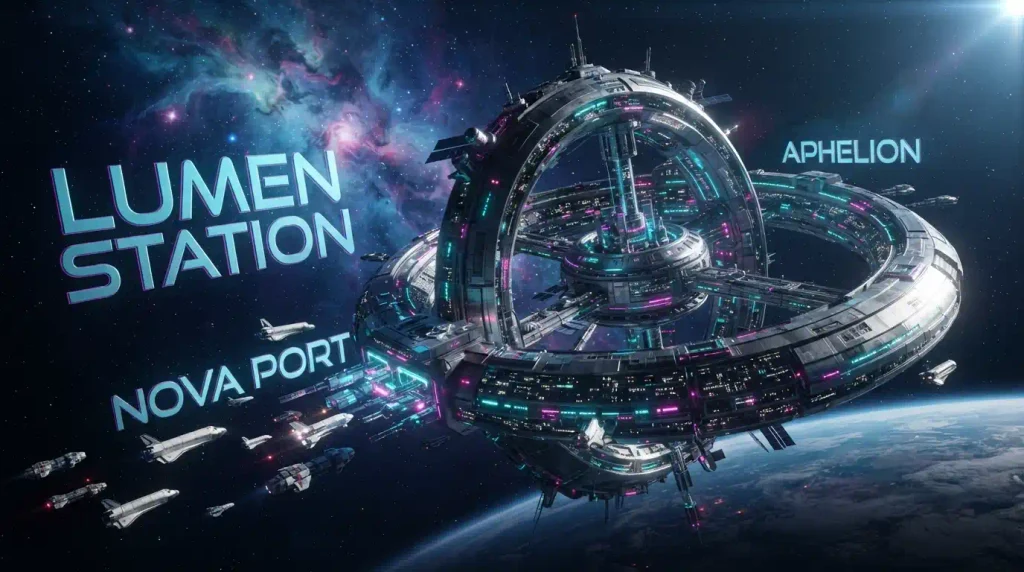
Even far-future settlements follow naming logic — they honor people, describe function, or borrow scientific terms. These keep that realism.
Kepler’s Rest
Meaning: Honors the astronomer Johannes Kepler.
Best For: Colonies named for scientists.
Ceres Junction
Meaning: Ceres is the dwarf planet in the asteroid belt.
Pronunciation: SEER-eez
Best For: Space-station trading posts.
Lumen Station
Meaning: A unit of light.
Best For: Orbital habitats.
Novaport
Meaning: “Nova,” a star that suddenly brightens, + port.
Best For: Interstellar docking towns.
Solace Outpost
Meaning: Comfort at a remote frontier station.
Best For: Survival stories.
Tessera
Meaning: A small tile in a mosaic.
Pronunciation: TESS-er-uh
Best For: Modular, grid-built cities.
Ionvale
Meaning: Charged particles in a valley.
Best For: Energy-harvesting colonies.
Vantage Prime
Meaning: A good viewpoint at the first or principal colony.
Best For: Flagship settlement names.
Aphelion
Meaning: The point in an orbit farthest from the sun.
Pronunciation: uh-FEE-lee-un
Best For: Cold, distant colonies.
Starlane
Meaning: A travel route between stars.
Best For: Trade-route towns.
How to Choose the Right Name
Match the name to the town’s function before you match it to your taste — a beautiful name that contradicts the town’s role will feel wrong to readers even if they can’t say why.
- Choose a soft, vowel-forward name if the town represents safety, home, or childhood, or if you want readers to feel the loss when a character leaves.
- Choose a blunt, consonant-heavy name if the town is a waypoint, if the economy is extractive (mining, logging, fishing), or if the name should sound chosen out of necessity.
- Choose an ominous name if the town’s history is the plot, or you want dread before anything happens.
- Choose an invented or archaic name if the setting is a secondary world, or you need the name to be searchable and unconfused with real places.
Two practical tests before you commit: say the name aloud as if a character is shouting it across a street, and then as if a narrator is using it in a first line. If it works in both, search the exact name plus “town” on a map — real collisions are common with compound English names, and knowing about them is better than discovering them after publication.
Final Shortlist Recommendations
These eight names are new to this section they don’t appear anywhere else in the article ranked by versatility, memorability, and ease of pronunciation. This is an editorial ranking, not a popularity statistic.
- Cinderholt — Best overall. Cinder + holt (a wood): a town that burned and grew back, usable in almost any genre.
- Bellhollow — Best for cozy mysteries. A bell ringing across a sheltered valley, with a hint that someone is being summoned.
- Wyrmrest — Best for fantasy. Suggests a place where something draconic settled — or was laid to rest.
- Amberquay — Best for coastal fiction. A warm-toned port; instantly visual and easy to pronounce.
- Thistlemarch — Best for frontier and borderland settings. Prickly, stubborn, and on the edge of somewhere.
- Duskholme — Best for gothic and horror fiction. Twilight plus an old word for a settlement, with quiet menace.
- Foxmere — Best for charming small-town fiction. Quick, warm, and slightly sly.
- Mistral Vale — Best for windswept coastal fantasy. Named for the cold Mediterranean wind, it carries weather in the name.
Frequently Asked Questions
What should I name my fictional town?
Choose the name by genre and mood first. Cozy stories suit soft nature words, comedies suit puns, and horror suits bleak landscape terms. Then narrow your candidates by saying each one aloud in a line of dialogue — the name that flows without explanation is usually the right one.
What are some names of fictional towns?
Well-known fictional towns include Castle Rock from Stephen King’s fiction, Stars Hollow from Gilmore Girls, and Mayberry from The Andy Griffith Show. All three feel plausible because they follow real place-name patterns — a landmark plus an old settlement suffix.
What are some unique town names?
Real-world oddities like Boring (Oregon), Accident (Maryland), and Why (Arizona) show how strange authentic names can be. For fiction, invented combinations — Vellamoor, Corvath, Pellumbra — give you the same freshness without borrowing a real community’s identity.
What are some fictional names for a small town?
Small towns usually pair a landscape feature with a simple suffix: Pinecrest, Cedar Hollow, Millbrook, and Fernwick all read as believable small towns rather than cities. Adding one specific detail — a mill, a single road, a bridge — makes the smallness feel intentional instead of generic.
What is a creative city name?
Creative city names combine two unexpected elements rather than one obvious one. Instead of “Goldtown,” try “Goldbriar” or “Cinderreach” — the tension between the two parts is what makes a name feel designed rather than generated.
How do I make sure my fictional town name isn’t already a real place?
Search the exact name plus “town” or “city” before you commit. If it exists somewhere small, you can still use it, but be aware some readers may picture the real location. Invented names with unusual letter combinations, like Ostmere or Umberlyn, rarely collide with real places.
Conclusion
The best fictional town name sounds like it existed long before your story began. If you want warmth, work from the cozy and aesthetic lists; if you want laughs, choose a pun in the Much-and-Nether tradition of English villages; if you want dread, the gothic names do that work before your first sentence does.
Frontier, coastal, and wilderness names borrow their authority from real geography, and the fantasy and sci-fi sections show that even invented worlds feel truer when the naming follows consistent internal logic.
Whatever you pick, run the two spoken tests, check a map, and then commit fully — a town name, like a real place, earns its meaning from the story built inside it. Choose your top three, write a paragraph set in each, and keep the one that makes you curious about who lives there.

About Sajjad Ahmed
Sajjad Ahmed is the founder and content creator behind Pressora Digital, a creative name-ideas platform dedicated to helping readers discover unique, meaningful, catchy, and memorable names. He focuses on creating practical naming resources covering baby and human names, pet and animal names, business and brand names, fictional and fantasy characters, gaming, social groups, and more.
Through Pressora Digital, Sajjad aims to make the naming process simpler by organizing useful ideas, themes, and naming inspiration in an easy-to-explore format.